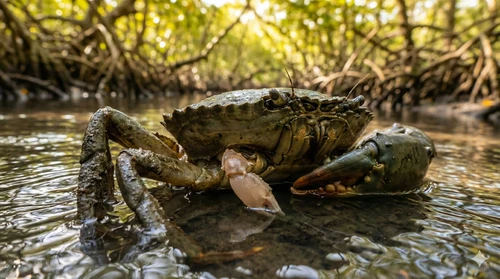
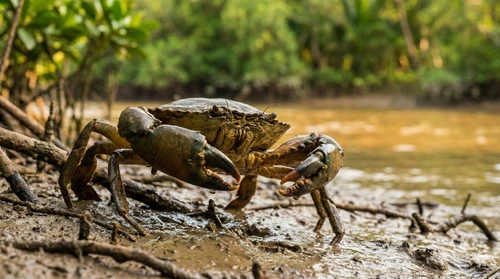
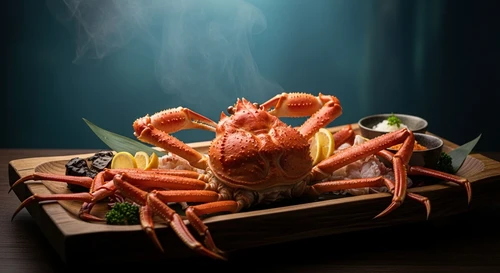
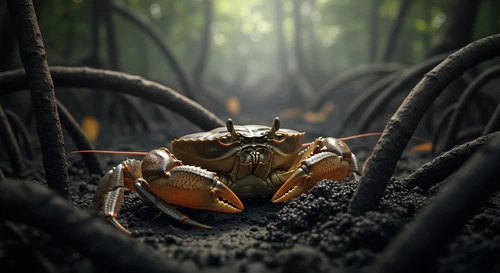
" There's a particular beauty in watching a mud crab scuttle across the delta floor, a masterclass in navigating unforgiving terrain. That primal efficiency, stripped down to code and steel, is now poised to explore realms beyond our reach. From the shimmering, chaotic life of the Mekong to the silent, crushing darkness of the deep ocean, the simple, brilliant engineering of the crab endures. "
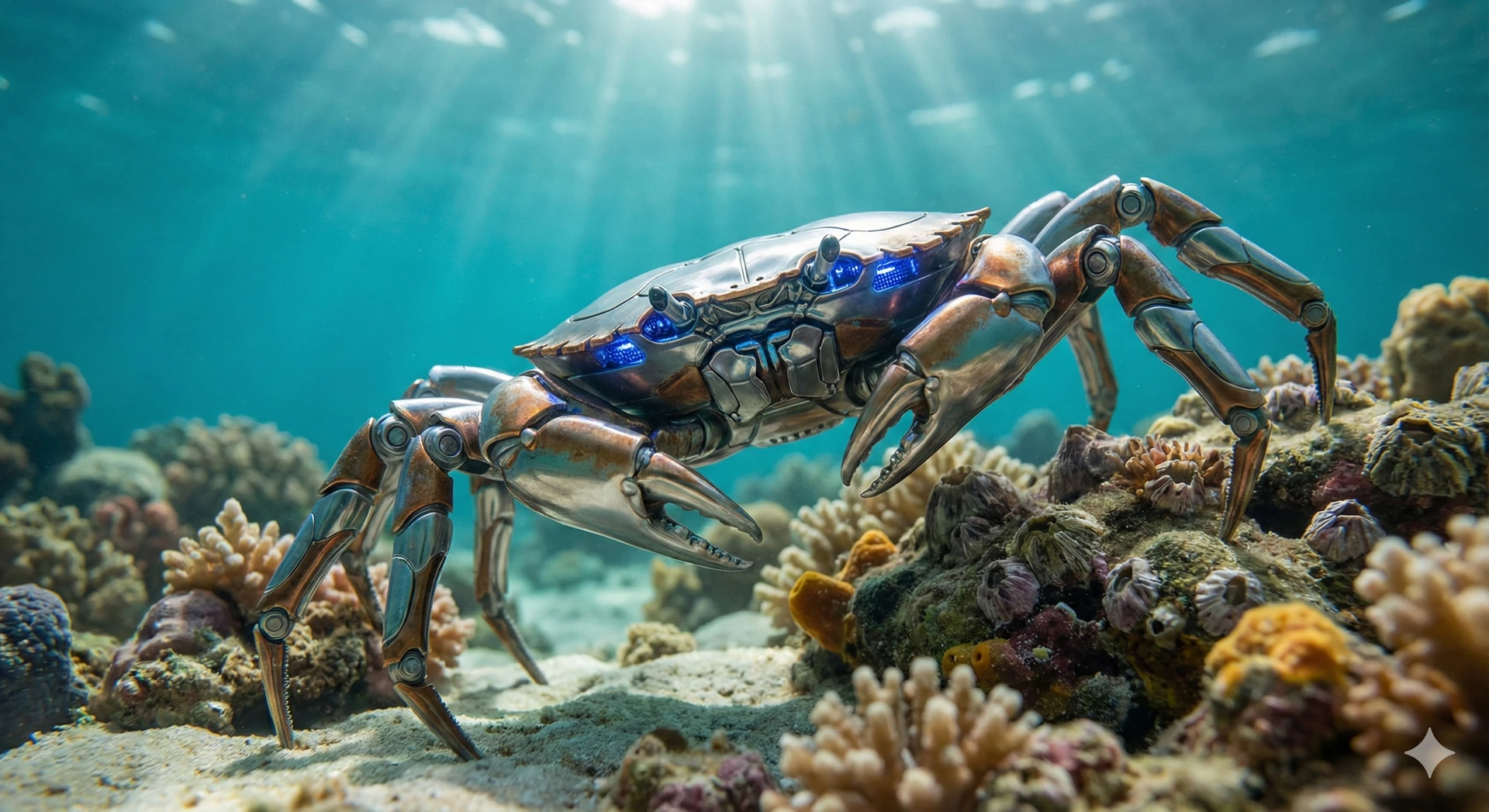
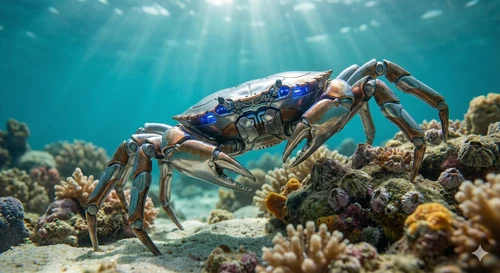
📸 A mechanical marvel, inspired by millions of years of natural evolution: The robotic crab navigating unseen depths.
1 The Delta's Unsung Engineers: Masters of Mud and Mangrove
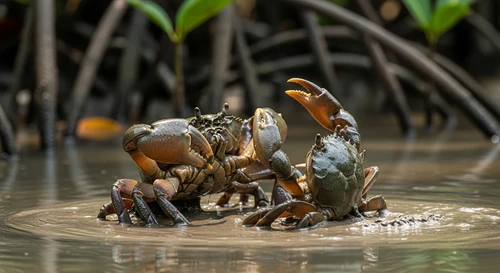
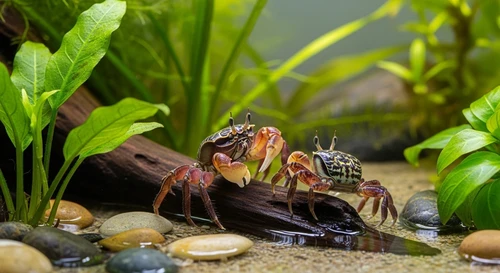
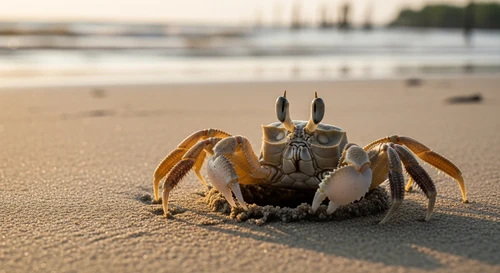
For eons, the Mekong Delta has been a grand stage for survival and adaptation, its muddy banks and intricate waterways teeming with life. Among its most resilient inhabitants are the myriad species of crabs – from the nimble fiddlers to the formidable mud crabs. These creatures are the silent, scuttling architects of this watery world, perfectly adapted to its rhythmic tides, treacherous mudflats, and dense mangrove forests. Spend a humid morning on a fishing boat near Ca Mau, the southernmost tip of Vietnam, and you'll witness their effortless grace – sidestepping currents, burrowing into soft earth, and navigating a labyrinth of roots and debris with an almost impossible agility. These creatures, seemingly simple, are in fact, evolutionary masterpieces, honed by millennia of environmental pressures.
It's this profound natural engineering, this intuitive command over challenging terrains, that has captured the imagination of scientists and roboticists across the globe. Why embark on decades of trial-and-error design for complex locomotion systems when nature has already perfected one over millions of years? The answer lies in biomimicry, where the ultimate teacher is found not in textbooks, but in the living laboratories of our planet.
2 Biomimicry: Nature's Blueprint for Uncharted Waters
The concept isn't novel; humanity has perpetually drawn inspiration from the natural world. From da Vinci's flying machines mirroring birds to the self-cleaning properties inspired by the lotus leaf, the most ingenious solutions often trace their origins back to Mother Nature. In the burgeoning field of robotics, this principle, known as biomimicry, is unlocking unprecedented frontiers, particularly in environments notoriously hostile to human exploration and conventional machinery.
Consider the deep sea: an unforgiving realm of crushing pressure, freezing temperatures, and impenetrable darkness. Here, traditional wheeled or tracked vehicles often prove impractical, sinking into soft sediments or struggling with uneven topography. This is precisely where the humble crab steps onto the technological stage – a robust, multi-legged marvel capable of traversing diverse seabeds with unparalleled stability and efficiency. Its segmented, armor-like exoskeleton offers intrinsic protection, while its numerous, independently articulating limbs provide not only redundancy but superior traction and adaptability, allowing it to "feel" its way through the most treacherous of paths.
3 The Anatomy of a Mechanical Marvel: Replicating the Crab's Genius
Translating the organic elegance and functional brilliance of a crab into a fully operational robot is a monumental engineering challenge. Roboticists delve deep into biomechanics, meticulously studying everything from the precise joint articulation of a crab's leg to the complex neural pathways that orchestrate its multi-limbed gait. The ambition extends beyond merely creating a robot that looks like a crab; the true goal is to engineer one that moves, adapts, and behaves with its inherent efficiency and resilience.
- Multi-Legged Locomotion: Most advanced robotic crabs feature six or eight legs, precisely mirroring their biological counterparts. This distributed limb system provides exceptional inherent stability, allowing the robot to maintain balance and continue locomotion even if one or two legs lose traction, encounter an unexpected obstacle, or experience a mechanical failure. This redundancy is critical in unpredictable environments.
- Advanced Articulation and Dexterity: Each robotic leg is typically equipped with multiple, independently actuated joints, often powered by sophisticated servomotors or hydraulic systems. This enables a remarkably wide range of motion, allowing the robot to adeptly step over sizable rocks, climb steep slopes, and adapt its gait in real-time to varying underwater terrain, much like a natural crab navigating a complex coral reef or a cluttered seabed.
- Sensory Perception and Environmental Awareness: Replacing the crab's natural eyes and antennae are arrays of advanced sensors. These include high-resolution cameras for visual mapping and identification, multibeam sonar for acoustic navigation and obstacle avoidance, pressure gauges to monitor depth, and chemical sensors to detect environmental parameters. This comprehensive sensory suite allows the robot to build a detailed understanding of its surroundings, detect hazards, and collect invaluable scientific data autonomously.
- Robust Exoskeleton and Materials: The robot's outer shell, or exoskeleton, is engineered to endure the most extreme conditions. This includes resisting the immense pressures of the deep ocean, combating the corrosive effects of saltwater, and withstanding impacts from debris or unforeseen contact. Materials like high-grade titanium alloys, specialized polymers, and composite materials are frequently employed to ensure maximum durability and longevity in hostile environments.
The monumental task of coordinating these multiple, complex limbs in a fluid, energy-efficient manner demands equally sophisticated control algorithms. These algorithms are often inspired by principles of neurobiology and collective behavior, simulating the decentralized control mechanisms observed in biological systems to achieve robust and adaptive locomotion.
4 Beneath the Waves: Where Robo-Crabs Roam
These mechanical crustaceans are far more than mere engineering curiosities; they are versatile tools poised to revolutionize our understanding and interaction with the deepest, darkest, and most dynamic corners of the marine world. Their unique locomotion makes them indispensable for tasks where precision and minimal disturbance are paramount.
Deep-Sea Exploration & Mapping
Robotic crabs are ideal for reaching hydrothermal vents, unexplored trenches, and abyssal plains. They can meticulously map vast expanses of the ocean floor, collecting geological, chemical, and biological samples without disturbing delicate ecosystems, all while withstanding extreme pressures that would crush traditional submersibles.
Underwater Infrastructure Inspection
Their stable footing and precise movements are perfectly suited for the detailed inspection of critical underwater infrastructure. This includes examining oil and gas pipelines, subsea communication cables, and the foundations of offshore wind turbines, identifying structural weaknesses, corrosion, or environmental damage with unparalleled accuracy.
Environmental Monitoring & Conservation
These robots can play a crucial role in monitoring the health of marine ecosystems. They can assess coral reef vitality, detect pollution hotspots, track the movements and health of marine life, and evaluate the long-term impact of climate change, providing vital data for conservation efforts.
Search, Recovery & Salvage Operations
Robotic crabs can significantly assist in challenging search and recovery missions. Whether locating sunken vessels, recovering lost equipment, or even aiding in disaster response underwater, their ability to navigate debris fields and uneven terrain makes them invaluable assets.
5 From Mangrove Mud to Deep-Sea Depths: The Crab's Universal Versatility
The profound beauty of the crab's evolutionary design lies in its incredible, almost universal versatility. A common mud crab from the Mekong Delta, a true pioneer of the dynamic intertidal zone, faces environmental challenges that are surprisingly analogous to those encountered thousands of meters below the ocean's surface. Both extremes demand a species (or a robot) that embodies:
- Unmatched Adaptability to Uneven Terrain: Whether it’s negotiating the soft, shifting mud and dense root systems of a mangrove swamp, or crawling over jagged rock formations, loose sediment, and delicate coral structures in the deep sea.
- Resilience Against Harsh, Variable Conditions: Withstanding dramatic salinity changes, powerful currents, extreme pressures, fluctuating temperatures, and the constant threat of erosion or impact from environmental forces.
- Efficient Movement with Limited Energy: The ability to perform both rapid scuttling when necessary and slow, precise crawling for delicate tasks, all while conserving precious energy – a critical factor for autonomous underwater vehicles.
- Inherent Protection from External Forces: A durable exoskeleton that offers defense against predators, impacts from floating debris, or the sheer, relentless force of deep-sea currents.
This fundamental adaptability, this exquisite balance of strength and agility, makes the crab an exceptional model for underwater robots that must operate autonomously and reliably in the most unpredictable and unforgiving conditions. Unlike wheeled vehicles that risk getting bogged down in soft sediment, or propeller-driven ROVs (Remotely Operated Vehicles) that can stir up delicate environments and consume significant power, legged robots can tread lightly, navigate precisely, and maintain their footing on virtually any surface, preserving the integrity of the ecosystem they explore.
6 The Silent Sentinels of Tomorrow's Oceans: Challenges & Opportunities
As these robotic crabs evolve, integrating advanced artificial intelligence, machine learning, and sophisticated communication systems, their roles will expand exponentially. Imagine swarms of autonomous crab-bots, working in concert, meticulously mapping entire ecosystems in 3D, detecting subtle changes in water chemistry, or even identifying new species in real-time. They could become the silent sentinels of our planet's aquatic realms, providing continuous, granular data that is vital for understanding and protecting our oceans more effectively than ever before.
However, with such powerful capabilities comes significant responsibility. The development of advanced, autonomous robots necessitates careful consideration of their ethical implications. Ensuring these machines are deployed purely for scientific discovery, environmental stewardship, and human benefit – and never for exploitation, surveillance, or ecological harm – is paramount. The lessons from nature extend beyond engineering blueprints; they also encompass the delicate, intrinsic balance of ecosystems and our moral obligation to preserve them.
7 The Delta's Enduring Legacy: Inspiring Limitless Innovation
Back in the vibrant, pulsating heart of the Mekong Delta, life continues as it has for millennia. The mud crabs, oblivious to their sophisticated technological counterparts, continue their vital work of aerating the soil, recycling nutrients, providing food for other species, and playing their indispensable part in the intricate web of life. Their unwavering efficiency, their sheer tenacity in a world of constant ebb and flow, serves as a powerful, humbling reminder: the greatest innovations often lie hidden in plain sight, waiting for us to observe with fresh eyes, to learn with open minds, and to adapt with ingenious hands.
Robotic crabs are far more than just a testament to human ingenuity or a showcase of engineering prowess; they are a profound and eloquent nod to the brilliance of natural selection. They eloquently remind us that to truly push the boundaries of technology, to explore the vast unknowns of our planet and beyond, sometimes we must first look back. Back to the simplest, most effective, and most elegant designs forged in the crucible of evolution – like those scuttling across the sun-drenched, fertile mudflats of Ca Mau.
8 Further Horizons: The Biomimetic Revolution Continues
The journey of robotic biomimicry is still in its nascent stages, yet its trajectory is breathtaking. Beyond the crab, researchers globally are drawing inspiration from an astonishing array of marine life – jellyfish for their soft robotics and efficient propulsion in water columns, fish for their streamlined hydrodynamics and agility, and even octopuses for their unparalleled manipulation capabilities with soft, dexterous arms. The ultimate goal is to create not just individual robots, but a diverse and interconnected fleet of biomimetic machines, each specialized for specific tasks, much like the myriad species that inhabit the Delta's waterways and the world's vast oceans.
Imagine a future where a coordinated effort of robotic "crabs" for seabed exploration, "fish" for long-range autonomous surveys, and "jellyfish" for delicate environmental sampling could collectively unlock the deepest secrets of our planet's last true wildernesses. From the crushing depths of the Marianas Trench to the pristine, unexplored under-ice caves of the Arctic, the possibilities are as boundless and uncharted as the oceans themselves. All this, thanks to the humble, tenacious, and endlessly inspiring crab – a true visionary from the muddy heart of the Mekong.
Dive Deeper into Tech Curiosities
Curious about other incredible ways nature inspires cutting-edge technology? The world is full of ingenious designs!
💡 Explore More Innovations