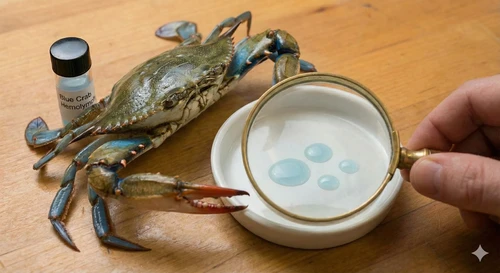
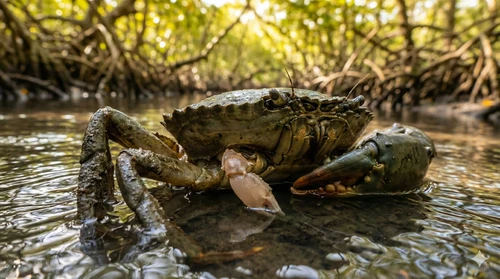
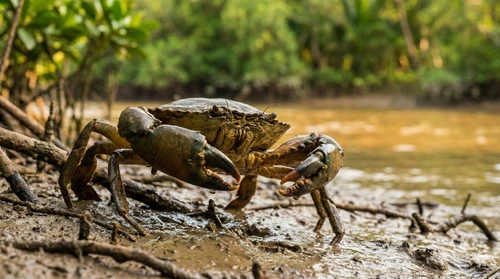
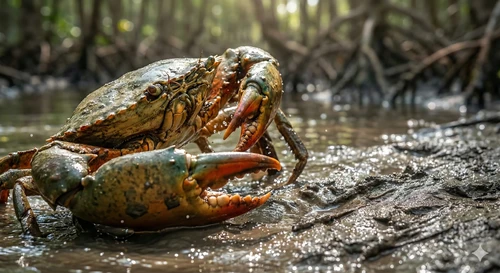
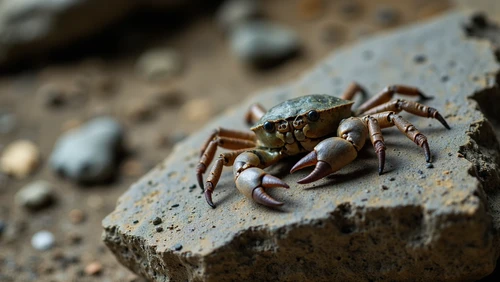
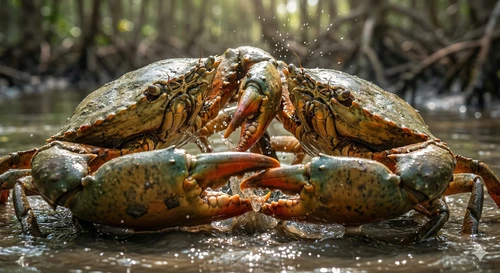
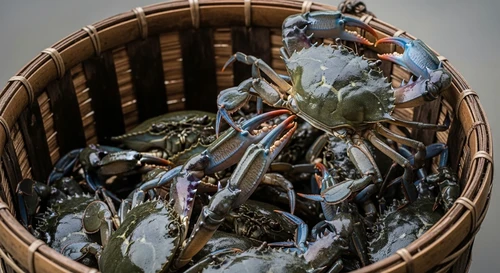
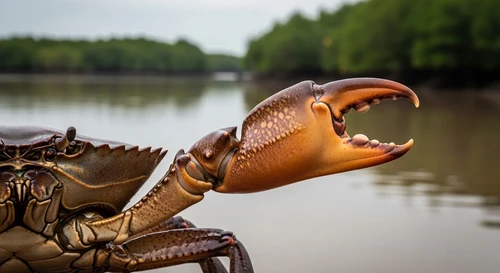
" The Mekong Delta is a labyrinth of life, where every ripple and mudflat hides a story. Today, we're diving into one of its most common, yet misunderstood, tales: the tale of two crabs that aren't really related at all. "
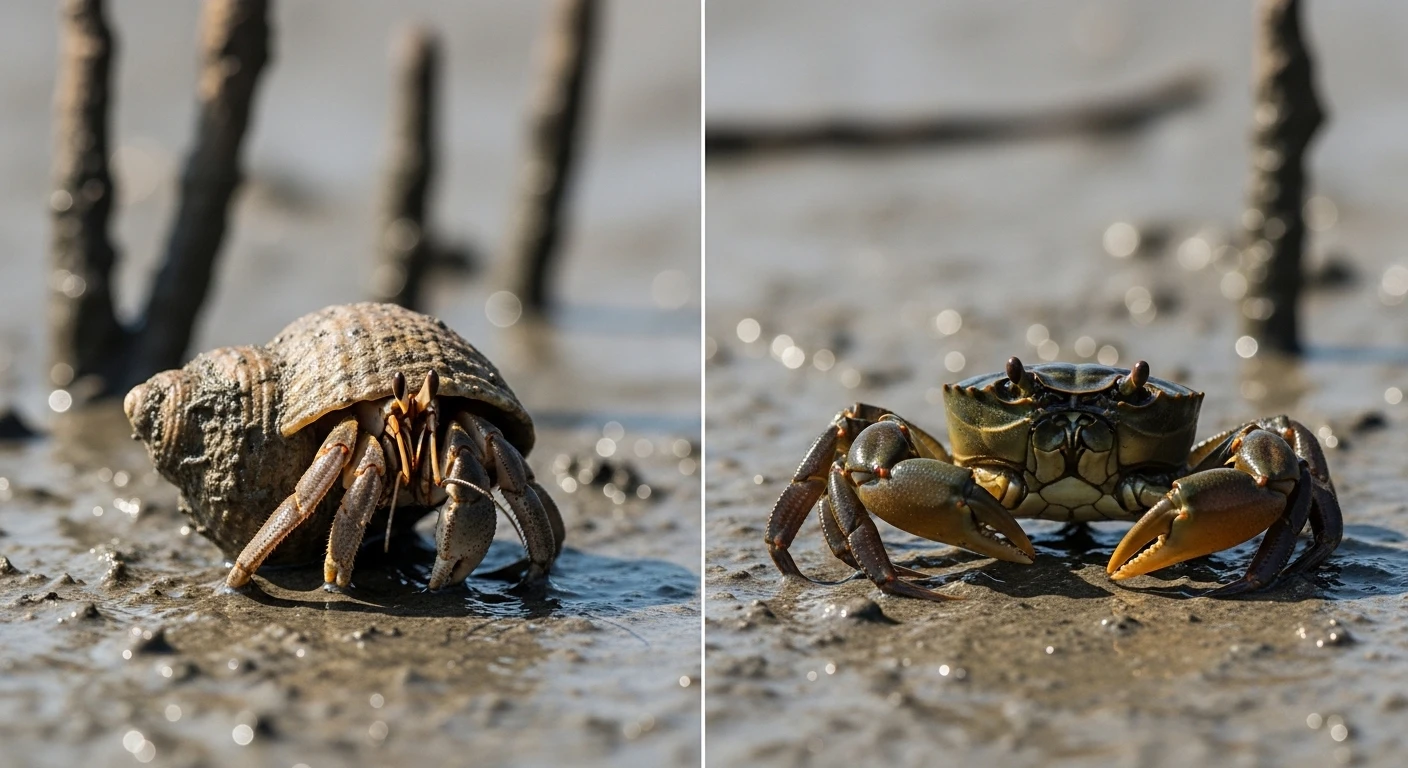
📸 Two common sights in the Delta, but one is an imposter in the crab family.
1 The Mekong Delta: A Stage for Biodiversity
If you've ever navigated the murky, life-giving waters of the Mekong Delta, you've witnessed an ecosystem teeming with an astonishing array of creatures. From the catfish wriggling in a street market to the elusive Irrawaddy dolphin, life here is vibrant, visceral, and often, delicious. Amidst this symphony of nature, two distinct crustacean figures often catch the eye: the ubiquitous hermit crab, scuttling across beaches or riverbanks in borrowed shells, and the robust, culinary-prized mud crab, often found burrowing deep in the delta's fertile silt.
They share a habitat, a general shape, and the common moniker of "crab." But to call them cousins would be a biological misstep as profound as calling a bat a bird. Let's peel back the layers of misconception and dive into the fascinating world of these two seemingly similar, yet fundamentally different, dwellers of the Delta.
2 The Master of Borrowed Homes: The Hermit Crab
Wander along any sandy stretch of coastline or estuary in the Mekong, and you're bound to encounter them: small, sometimes skittish, creatures dragging their homes behind them. These are the hermit crabs, members of the infraorder Anomura. Their most defining characteristic is, of course, their mobile home – a discarded gastropod shell. This isn't just a quirky fashion statement; it's a matter of survival.
Unlike "true" crabs, hermit crabs possess a soft, asymmetrical abdomen that is highly vulnerable to predators. To protect this soft underbelly, they must constantly search for and occupy empty snail shells. As they grow, they embark on perilous quests to find larger, more fitting accommodations, a spectacle that can turn into a frantic real estate battle among individuals. Their reliance on these external shelters is the first major clue that sets them apart from their hard-shelled counterparts.
Their two large claws, often of unequal size, are used for feeding, defense, and blocking the entrance to their shells when threatened. The smaller pair of walking legs helps them grip the inside of their shells, while the last two pairs are tiny, tucked away inside, aiding in shell manipulation.
3 The Armored Native: The Mighty Mud Crab
Now, let's talk about the mud crab (often from the genus Scylla), the undisputed heavyweight of the Mekong Delta's intertidal zones. These are the "true" crabs, belonging to the infraorder Brachyura. Picture a creature built for battle: a broad, flattened, and incredibly tough carapace (the upper shell) that fully encloses and protects its entire body, including its segmented abdomen which is tucked neatly underneath.
Mud crabs are robust, powerful, and perfectly adapted to their estuarine environment. Their strong, paddle-like hind legs are excellent for swimming, while their formidable claws can crush shells with ease, making them expert predators of smaller crustaceans and mollusks. They burrow deep into the mud and sand, emerging to hunt during high tide or forage for detritus. Their presence is a sign of a healthy mangrove ecosystem, crucial for the delta's overall health.
For locals and visitors alike, the mud crab is a culinary star, celebrated for its sweet, rich meat, especially during certain seasons when the females are laden with vibrant roe. Dishes featuring mud crabs are a highlight of Mekong Delta cuisine, a testament to their robust flavor and generous size.
The Biological Chasm: It's All in the Abdomen
The core difference lies not just in their living arrangements, but in their fundamental body plan and evolutionary path.
Hermit Crabs (Anomura)
- Soft, asymmetrical abdomen: Unprotected, hence the need for a shell.
- Reduced last pair of legs: Tucked inside the shell for grip.
- "False crabs": Share some features with true crabs but are more closely related to squat lobsters.
- Larval stages: Differ significantly from true crab larvae.
Mud Crabs (Brachyura)
- Hard, symmetrical abdomen: Tucked firmly under the carapace, fully protected.
- Four well-developed pairs of walking legs: No need for external shelter.
- "True crabs": Possess a calcified, protective exoskeleton over their entire body.
- Specialized gills: Adapted for efficient respiration in water and air.
Think of it this way: a hermit crab is like a squishy person forced to live in a tent, while a true crab is wearing full plate armor, custom-fitted and permanently attached.
5 Lives Forged by Biology: Adaptation in Action
This fundamental biological difference dictates almost every aspect of their lives. Hermit crabs, constantly seeking new homes, are often observed in transitional zones, where empty shells are plentiful. They are scavengers, opportunistic feeders, and their entire behavioral repertoire revolves around finding, protecting, and upgrading their living quarters. Their existence is a frantic dance of resourcefulness and vulnerability.
Mud crabs, on the other hand, embody resilience and power. Their robust armor allows them to dominate their muddy domains, digging intricate burrows that provide refuge from predators and extreme environmental conditions. They are formidable hunters, actively pursuing prey, and their life cycle, from tiny zoea larvae to mature adults, is one of self-sufficiency. They don't need to borrow; they build their own protection, piece by piece, from within.
The Mekong's ebb and flow, its tidal rhythms and rich sediment, provide the perfect backdrop for both these survival strategies. One hides, the other confronts; both thrive in their unique ways.
6 From Mud to Market: A Culinary Divide
While both are crustaceans found in the Delta, their fates on the dinner table are vastly different. The mud crab is a celebrated ingredient, starring in an array of Vietnamese dishes. You'll find them steamed with beer or coconut water, stir-fried with tamarind, or simmered in a rich curry. Their firm, sweet, and succulent meat is a delicacy, a true taste of the Mekong's bounty. The effort of cracking shells and extracting meat is a labor of love, a communal experience shared over bustling tables.
Hermit crabs, however, are rarely, if ever, considered food in Vietnam. Their small size, relatively sparse meat, and the difficulty of extraction make them unappealing for culinary purposes. They are observed, admired for their quirky behavior, but left to their important roles as scavengers in the ecosystem. This divergence in their gastronomic value further highlights their distinct biological paths and how humans interact with them.
7 Into the Mangroves: Where to Find Them
If you're exploring the Mekong Delta and want to witness these fascinating creatures firsthand, you'll find them in slightly different niches.
- Hermit Crabs: Look for them in sandy coastal areas, particularly around tidal flats and the edges of estuaries. They're often more active at low tide, scuttling about in search of food and new shells. Beaches near Phu Quoc or the coastal areas of Ca Mau province are good spots.
- Mud Crabs: These require a keen eye and often a boat trip deeper into the mangrove forests and muddy estuaries. They're masters of camouflage and burrowing. Local fishermen or eco-tour guides in areas like Nam Can (Ca Mau) or Can Gio (just outside Ho Chi Minh City) can often point out their burrows or even demonstrate traditional crabbing techniques.
Observing them in their natural habitat offers a much richer understanding of their unique adaptations than any textbook ever could.
8 More Than Meets the Eye
So, the next time you see a "crab" in the Mekong Delta, take a moment. Is it dragging a borrowed home, or is its armor a permanent, self-made shield? The distinction between the hermit crab and the mud crab isn't just a biological footnote; it's a testament to the incredible diversity of life and the myriad ways evolution crafts creatures perfectly suited to their environments.
This simple comparison unlocks a deeper appreciation for the delta's intricate ecosystems, reminding us that even the most common sights hold surprising truths. The Mekong, as always, invites you to look closer, to question, and to marvel at its enduring, sometimes hidden, charms.
Dive Deeper into Delta Life
Curious about other fascinating creatures or cultural insights from Vietnam's watery south?
🌊 Explore More Curiosities