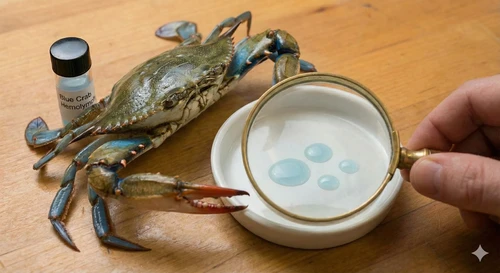
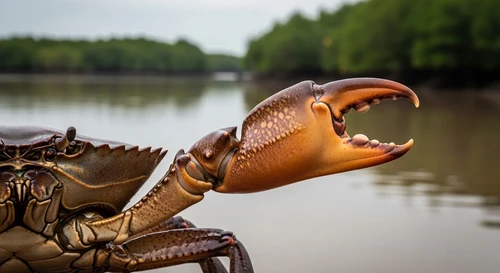
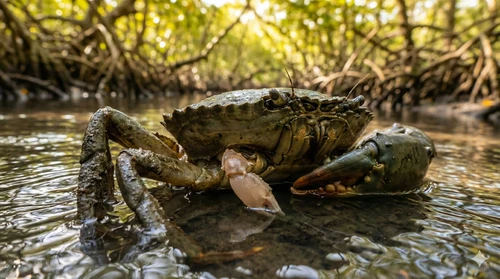
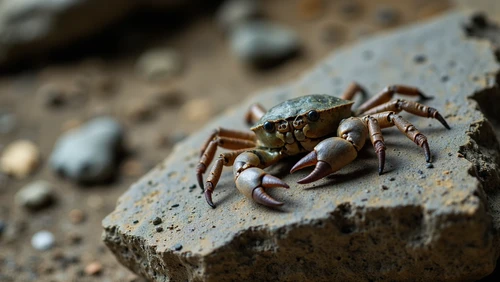
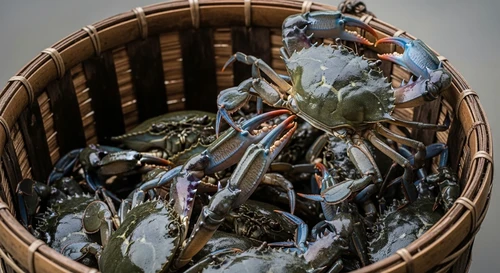
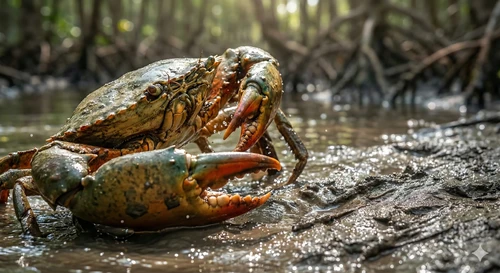
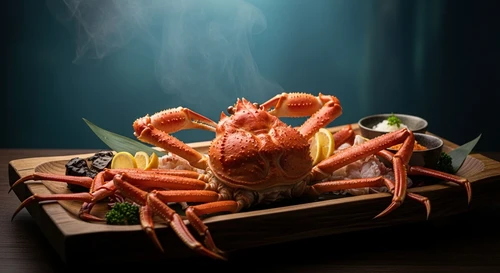
" To truly understand the Mekong Delta, you must first comprehend its deep roots. Not just the mangroves, but the very bedrock of time, where creatures like the humble crab have etched their story for eons. They were here before us, and in their ancient shells, we find a testament to life's enduring resilience. "
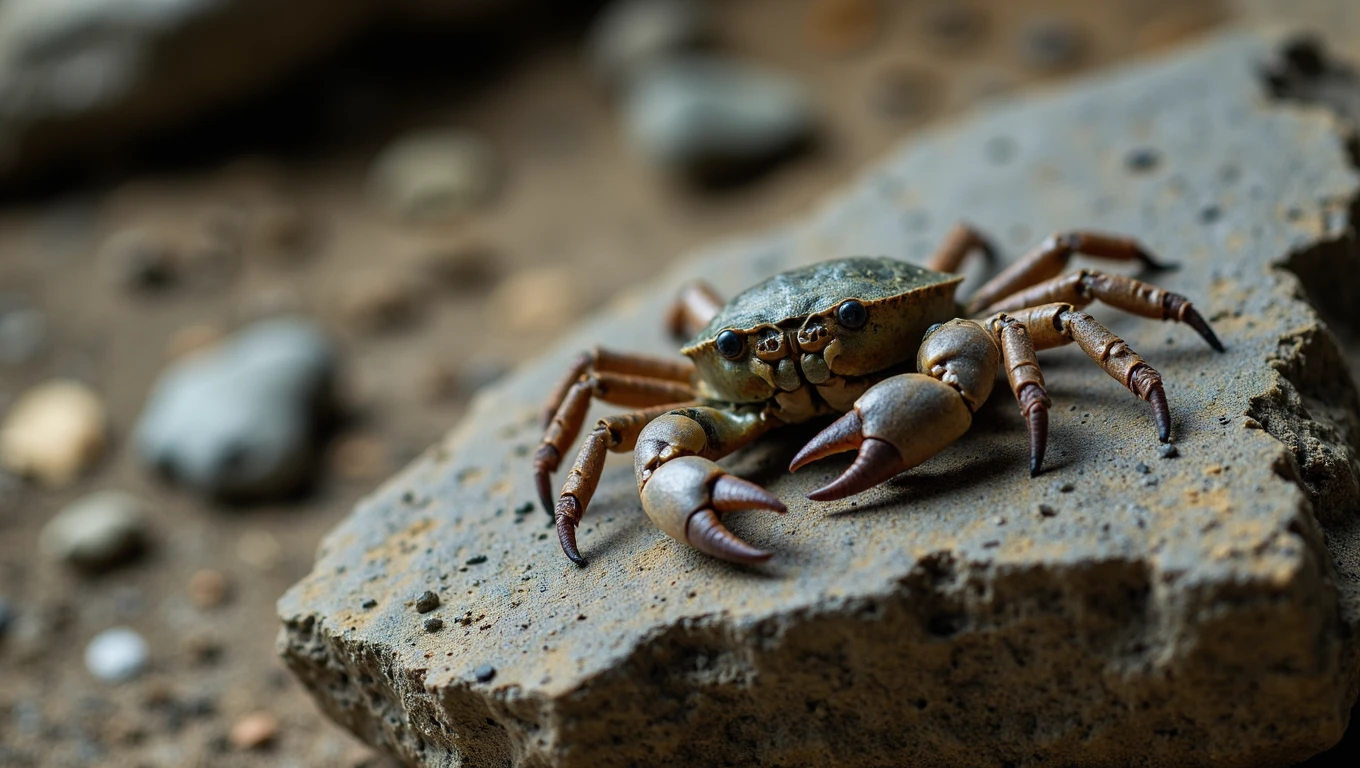
📸 A window into deep time: The silent, stony testimony of an ancient crab.
1 The Deep Time Delta: Where Pincers Met Prehistory
When we speak of the Mekong Delta, images of lush rice paddies, bustling floating markets, and a tapestry of water and life immediately come to mind. But beneath this vibrant surface lies a story infinitely older, a chronicle etched in stone, stretching back millions of years. This isn't just a tale of present-day bounty; it's a profound journey into the geological past, a time when the very landscape of what would become Vietnam was a canvas for different, equally compelling forms of life.
It's a humbling thought: the crabs we savor today, plucked from the muddy banks and fresh waters, are direct descendants of creatures that witnessed the age of dinosaurs. The delta's rich ecosystem, its very ability to sustain such prolific crustacean life, has its genesis in these ancient seas and shifting landmasses. The story of ancient crabs is not separate from the Mekong; it's the fundamental, foundational first chapter.
To truly appreciate the mud crab on your plate or the tiny fiddler crab scuttling through the mangroves, one must pause and consider the immense span of time these resilient arthropods have endured, adapted, and thrived through. Their ancient history informs their present ubiquity, their biological success a testament to millions of years of evolutionary refinement.
2 Jurassic Survivors: Crabs' Ancient Lineage Unveiled
The description "Crabs have walked the earth since the Jurassic period" isn't a hyperbolic flourish; it's a scientific fact. For roughly 150 million years, these fascinating decapod crustaceans have been evolving, diversifying, and adapting to nearly every aquatic and semi-aquatic environment on the planet. Imagine a world dominated by colossal dinosaurs, vast prehistoric oceans, and landscapes vastly different from today – yet, amidst this ancient grandeur, crabs were already navigating their existence, their iconic, hardened shells and scuttling gait surprisingly unchanged in fundamental form.
Early crab fossils, like those of the family Callianassidae (mud shrimps, close relatives of true crabs), date back to the early Jurassic. These creatures were often smaller, perhaps less complex than their modern counterparts, but they already possessed the basic body plan that would prove so successful: a sturdy exoskeleton, ten legs, and often, formidable pincers. Their adaptability allowed them to survive mass extinctions that wiped out countless other species, proving that sometimes, being a resilient, bottom-feeding scavenger is the ultimate survival strategy.
This enduring lineage means that every crab we encounter today carries within its genetic code the echo of those ancient survivors. They are living fossils, in a sense, a direct link to a time when the world was a dramatically different place, but where the basic principles of life and survival were already being written in the mud and sand.
3 Whispers from the Stone: Decoding Crab Fossils
Fossils are not merely old bones or hardened imprints; they are storytellers. Each fossilized crab shell, each delicate claw, is a paragraph in the geological narrative, offering invaluable insights into ancient environments, climates, and ecological interactions. Imagine a paleontologist carefully chiseling away rock, revealing the exquisite detail of a crab that died perhaps 100 million years ago. What can this ancient testimony tell us?
Firstly, the presence and type of crab fossils found in a particular sedimentary rock layer can indicate if the area was once marine, brackish, or freshwater. The morphology of the crab—its size, shape, and the development of its claws—can hint at its lifestyle: was it a burrower, a predator, a scavenger? Did it live in shallow coastal waters, deep seas, or perhaps even on land? For instance, the discovery of early freshwater crab fossils helps pinpoint the emergence of land-based crab species, a significant evolutionary leap.
Beyond individual characteristics, fossil assemblages—groups of different species found together—paint a picture of entire ancient ecosystems. They help scientists reconstruct food webs, understand species distribution through time, and even track major environmental changes, like rising or falling sea levels, shifts in ocean currents, or periods of intense volcanic activity. These silent sentinels, preserved in stone, are crucial keys to unlocking Earth's biological and geological past, providing a profound context for the living world we inhabit today.
4 The Unseen Architects: How Ancient Crabs Shaped Ecosystems
It's easy to view crabs as simple bottom-dwellers, but their impact on aquatic and coastal ecosystems, both ancient and modern, is anything but trivial. They are, in many ways, unseen architects, constantly shaping and reshaping their environments. From the Jurassic onwards, crabs played crucial roles in sediment bioturbation—the stirring and mixing of sediments. Their burrowing activities aerated the substrate, releasing nutrients and creating habitats for other organisms. This constant churning helps to maintain healthy benthic (seafloor) environments, preventing stagnation and promoting biodiversity.
Furthermore, crabs have always been critical components of food webs. As omnivores, they consume detritus, algae, and smaller invertebrates, effectively recycling nutrients and keeping ecosystems clean. In turn, they serve as a vital food source for a myriad of predators, from fish and cephalopods in ancient oceans to birds, mammals, and, of course, humans in the Mekong Delta today. This dual role as both consumer and consumed has cemented their place as linchpins in the delicate balance of life.
The evolutionary success of crabs, evidenced by their ancient fossil record, is a testament to their ecological efficiency. They adapted to different salinity levels, temperatures, and food sources, allowing them to colonize new niches and continue their work as nature's diligent clean-up crew and organic landscapers. The vibrant, thriving delta we see today owes a silent debt to these millennia of unnoticed, invaluable ecological contributions.
5 Global Wanderers: Tracing Crab Fossils Across Continents
The story of ancient crabs is not confined to a single locality; it's a global epic. Fossil discoveries have been made on every continent, from the shores of ancient North America to the arid landscapes of what was once a submerged Europe, and yes, even in the geological formations that underpin Southeast Asia. Each discovery adds another piece to the intricate puzzle of crustacean evolution and ancient paleogeography.
Paleontologists have unearthed remarkably preserved specimens in amber from Myanmar, offering exquisite detail of tiny, often parasitic, crabs that lived among dinosaurs. In Japan, beautifully detailed fossils from the Oligocene period (roughly 30 million years ago) showcase species remarkably similar to modern-day deep-sea crabs. These findings aren't just fascinating relics; they serve as critical data points for understanding continental drift, ancient oceanic currents, and the dispersal patterns of marine life.
The global distribution of crab fossils underscores their immense adaptive capacity. They were not just confined to specific habitats but colonized diverse environments, evolving into myriad forms that filled nearly every available niche. This global presence allows scientists to correlate geological layers across vast distances, using crab fossils as bio-indicators to date rock formations and understand the interconnectedness of ancient seas. It reinforces the idea that life on Earth has always been a vast, interconnected web, transcending geographical boundaries even millions of years ago.
6 Mekong's Ancient Crustaceans: A Local Legacy
While the most spectacular fossil finds might often come from more tectonically active regions, the Mekong Delta, with its dynamic geological history shaped by massive riverine sedimentation and sea-level changes, undoubtedly holds its own ancient secrets. The delta's current landmass is relatively young in geological terms, built up over tens of thousands of years by the mighty Mekong River's alluvial deposits. However, the underlying geological strata, formed millions of years ago, certainly contain the remnants of ancient marine and brackish environments where crabs would have thrived.
Specific fossil discoveries within Vietnam and surrounding Southeast Asian regions affirm a rich ancient crustacean presence. These finds often include not just the full body fossils but also trace fossils—burrows, tracks, and feeding marks—left behind by ancient crabs. These subtle indicators provide a window into their behaviors, showing us that the fundamental activities of digging, scavenging, and mating have persisted for geological epochs.
The Mekong's unique blend of freshwater, brackish, and marine habitats has been a constant draw for crabs, fostering incredible biodiversity. This present-day richness is a direct inheritance from their ancient ancestors, who pioneered adaptation to these varied conditions. When you see a fiddler crab waving its oversized claw in the delta's mudflats, or crack open a succulent mud crab caught in its estuaries, you are engaging with a lineage that has called this region, in its various ancient forms, home for an unimaginable expanse of time. It's a living legacy, a continuum that connects the prehistoric past to the Mekong's vibrant present.
7 A Million-Year Menu: The Culinary Echoes of Prehistoric Crabs
As a food journalist with a deep love for the Mekong Delta, it's impossible to discuss crabs without eventually turning to the plate. While our ancient ancestors certainly weren't simmering crab with beer and lemongrass, the fundamental appeal of crab meat—its sweet, delicate flavor and satisfying texture—has likely been a consistent draw for any creature, including early hominids, capable of cracking its shell. The very abundance and accessibility of crabs, stemming from their long evolutionary success, would have made them a reliable food source throughout history.
Consider the enduring culinary tradition of the Mekong Delta, where crabs are not just food, but a way of life. From the iconic Ca Mau mud crab, prized for its firm meat and rich roe, to the smaller rice paddy crabs used in local broths and fermented sauces, these crustaceans are deeply interwoven with the region's identity. This sustained human interaction with crabs, spanning millennia, echoes the deep-time relationship these animals have had with their environment. Their success as a species translates directly into their importance on the human menu.
The resilience and adaptability that allowed crabs to survive mass extinctions and thrive across diverse geological periods also made them a sustainable and accessible protein source for emerging human populations. So, when you're cracking open a crab in the delta, remember that you're not just enjoying a meal; you're participating in a million-year legacy, savoring the fruit of an evolutionary journey that began in the age of dinosaurs. It's a taste of history, a flavor of deep time, brought directly to your table by the enduring spirit of the Mekong.
8 Silent Sentinels: Preserving the Past for Future Generations
Understanding the ancient history of crabs, particularly in a dynamic region like the Mekong Delta, is more than just an academic exercise; it's a critical component of conservation. The fossil record provides a baseline, a glimpse into how ecosystems functioned before significant human impact. By studying ancient crabs and their environments, scientists can better understand long-term ecological shifts, predict future changes, and inform conservation strategies for modern crab populations and their habitats.
The Mekong Delta, like many coastal regions globally, faces immense environmental pressures from climate change, overfishing, and habitat destruction. Protecting the delta's mangroves, its intricate network of canals, and its delicate estuaries is not just about preserving the current ecosystem; it's about safeguarding a living lineage that has endured for hundreds of millions of years. Each living crab in the delta is a direct, vibrant link to those Jurassic ancestors, a testament to an unbroken chain of life.
The fossils are silent sentinels, reminding us of the fragility and resilience of life, and the vast span of time over which species have evolved and persisted. By appreciating this deep history, we cultivate a deeper respect for the natural world and our responsibility to protect it. Our engagement with the Mekong Delta, whether through its incredible food or its breathtaking landscapes, becomes richer when viewed through the lens of deep time, understanding that we are temporary custodians of an ancient and profound legacy.
Unearthing Answers: Common Questions
🌍 Where are most crab fossils found?
🗓️ How old are the oldest known crab fossils?
🔬 What can we learn from a crab fossil?
Dive Deeper into Mekong's Wonders
The Mekong Delta holds countless stories, from ancient history to vibrant present-day ecology. Explore more of its hidden gems and natural marvels.
🌿 Discover Mekong Biodiversity