" There's a particular kind of hunger in the Mekong Delta. It's not just for the next meal, but for survival, for progress. And sometimes, it breeds a dark twin: the hunger to keep others from rising. "
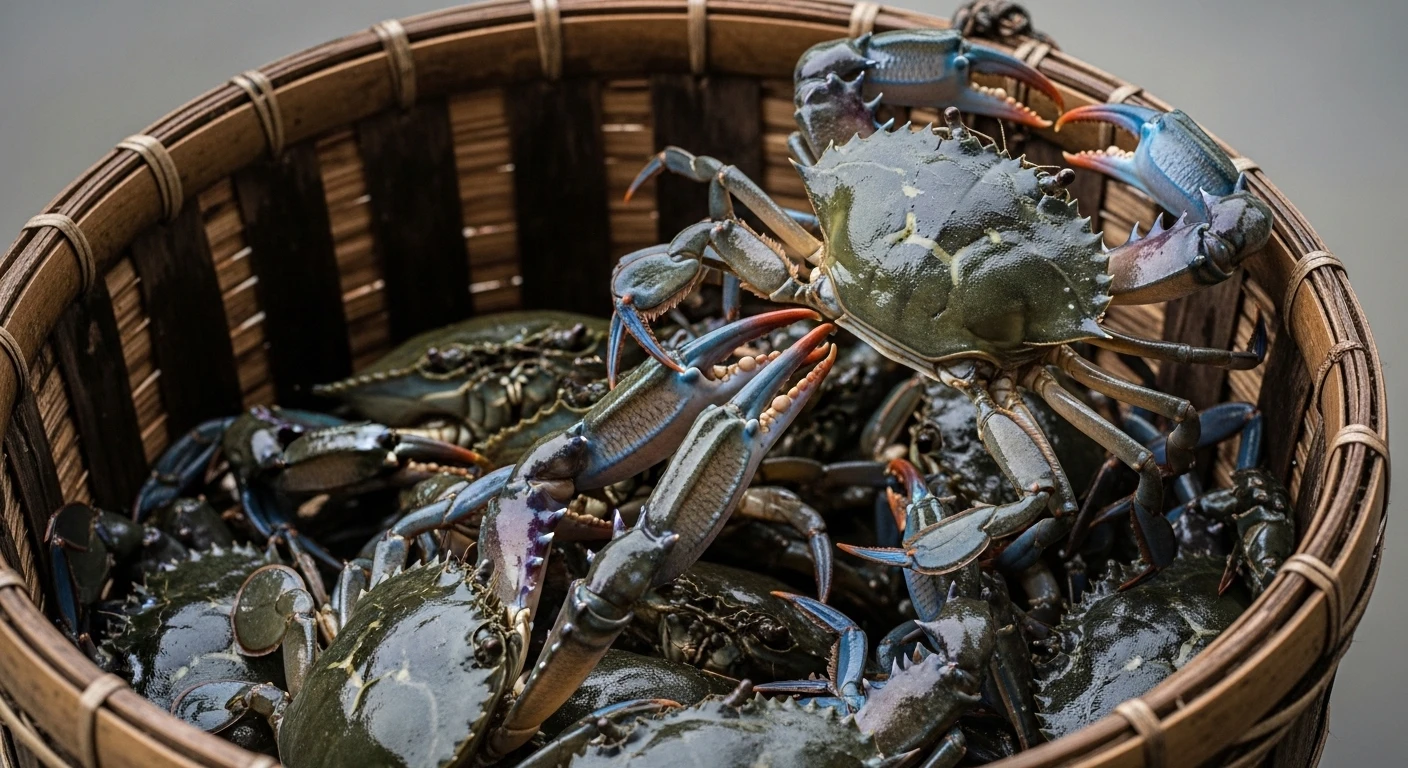
📸 The struggle is real: A stark visual of the human condition reflected in a simple bucket.
1 The Mekong's Grasp: From Mud to Metaphor
Along the sinuous veins of the Mekong Delta, life pulses with an untamed energy. Here, the land and water yield a bounty that feeds generations, and nowhere is this more evident than in the abundance of its crustaceans. From the brackish swamps of Ca Mau to the fertile rice paddies, crabs are a staple, a livelihood, and ironically, the unwitting symbol of a profoundly human flaw.
As a journalist who has spent countless sunrises observing the delta's rhythms, I've seen mud crabs, blue crabs, and swimming crabs pulled from traps, their shells gleaming under the nascent light. They are collected in woven baskets or simple plastic buckets, destined for the market or a communal meal. It's in these moments, watching them scramble, that the chilling metaphor truly comes to life: "Crab Mentality."
It’s a concept that resonates deeply in societies across the globe, yet nowhere does its raw, visceral origin feel more palpable than amidst the very creatures it's named after.
2 A Fisherman's Tale: The Origin of a Cruel Metaphor
Picture a fisherman, sweat beading on his brow, returning from a dawn trip to the mangrove forests of Nam Can. He empties his net into a bucket. Inside, a chaotic mass of crabs, all identical in their frantic struggle. One, bolder or perhaps simply luckier, begins to climb. Its claws find purchase on the rim, its body straining upwards, inching towards freedom. But then, a cruel ballet unfolds.
Another crab, from below, extends a claw. Not to help, but to grip the climber’s leg, pulling it back into the writhing heap. Then another, and another, until the hopeful escapee is dragged back down, destined to share the fate of the collective. The fisherman, observing this, needn't bother with a lid. He knows the crabs will do the work for him.
This isn't just a quaint observation from the delta. It's a stark, powerful image for a human psychological phenomenon: when members of a group try to pull down any member who achieves or tries to achieve success beyond the others, out of envy, resentment, or a false sense of loyalty to the struggling majority.
3 The Unseen Weight: What is "Crab Mentality"?
At its core, "crab mentality" describes a self-destructive dynamic. It's a phenomenon where individuals, instead of supporting or celebrating the achievements of others, actively undermine them. This behavior stems from a fear that another's success diminishes their own, or that if someone else escapes the metaphorical "bucket," it highlights their own stagnation.
It's a collective mindset that ensures no one rises above the rest, even if it means dragging everyone down. It's often fueled by a potent cocktail of:
- Envy: Resentment of another's qualities, possessions, or success.
- Insecurity: A deep-seated fear of one's own inadequacies or failures, projected onto others.
- Lack of Self-Esteem: The belief that one isn't good enough, leading to attempts to diminish others to feel better.
- Tribalism: A misguided sense of group loyalty, where individual success is seen as a betrayal of the struggling collective.
4 Why We Pull: The Psychology of Envy and Insecurity
To understand crab mentality, we must delve into the murky waters of human emotion. Envy, a corrosive acid, eats away at appreciation and replaces it with bitterness. It’s not just wanting what someone else has; it's wanting them *not* to have it. Psychologists suggest that envy often arises when we compare ourselves to others who are similar to us in some way, making their success feel like a direct threat to our own standing.
Insecurity acts as the prime mover. When people feel inadequate, the success of a peer can be incredibly threatening. Instead of inspiring them to strive for their own goals, it triggers a defensive mechanism. They might think: "If they succeed, what does that say about me? Maybe I'm not good enough, and I don't want to be left behind or feel worse about myself."
This isn't always malicious. Sometimes, it's a subconscious act born from deep-seated fear and self-doubt. It's a tragedy that unfolds silently, unseen by the wider world, much like the slow erosion of a riverbank in the delta.
5 Silent Sabotage: Recognizing the Signs in Daily Life
Crab mentality isn't always a dramatic public takedown. Often, it manifests in subtle, insidious ways, like the slow creep of salt water into a freshwater field. In the Mekong Delta, where community ties are strong, a single success story can sometimes be met with quiet murmurs rather than boisterous celebration.
How does it show up?
- Undermining comments: "Oh, he only got that promotion because he's a workaholic, sacrificing his family."
- Gossip and slander: Spreading rumors or exaggerating flaws to discredit someone's achievement.
- Backhanded compliments: "Your idea was good for a beginner."
- Passive-aggressive behavior: Withholding support, information, or resources from someone who is excelling.
- Diminishing achievements: Downplaying someone's hard work ("It was just luck").
- Social exclusion: Isolating individuals who are perceived as "too successful" or different.
These acts, though seemingly small, chip away at morale, stifle innovation, and create an environment where mediocrity becomes the safest harbor. It keeps everyone, metaphorically, stuck in the same bucket.
6 Breaking the Claws: Strategies for Personal Liberation
Escaping the crab mentality requires conscious effort, much like navigating a sampan through a dense maze of water hyacinths. It begins with self-awareness and a firm resolve not to become one of the "pullers," nor to be pulled down yourself.
- Recognize the pattern: Be vigilant about your own thoughts and reactions to others' success. Is it genuine joy, or a flicker of resentment?
- Shift your mindset: Reframe success as abundant, not scarce. Someone else's gain doesn't mean your loss. Instead, view it as inspiration or proof of what's possible.
- Focus on your path: Instead of comparing, invest your energy into your own goals and growth. The Mekong flows, ever forward; so should you.
- Cultivate empathy: Understand that behind every success is often struggle. Celebrate their journey, not just the outcome.
- Set boundaries: If you're consistently around people exhibiting crab mentality, limit your exposure or communicate your discomfort. Protect your positive energy.
- Be a supporter: Actively lift others up. Be the hand that helps, not the claw that drags.
This isn't about ignoring challenges or criticism, but about discerning between constructive feedback and destructive sabotage.
7 Cultivating the Mangrove Mindset: Fostering Support, Not Scrutiny
The Mekong Delta’s mangrove forests are a powerful symbol of collective strength. Their tangled roots interlock, creating an impenetrable barrier against erosion, sheltering diverse ecosystems. They don't compete; they collaborate for survival. This is the antidote to crab mentality.
Imagine a community, a team, or a family where:
- Success is shared and celebrated genuinely.
- Mistakes are seen as learning opportunities, not reasons for ridicule.
- Mentorship and guidance replace jealousy and competition.
- Vulnerability is embraced, fostering deeper connections.
- Every individual's unique contribution is valued.
This "mangrove mindset" is about understanding that when one rises, the potential for all to rise increases. It’s about building a robust, resilient system where mutual support is the norm, not the exception. It might sound idealistic, but it's a profound shift that begins with individual choice.
8 A Delta Dream: Imagining a World Beyond the Bucket
The Mekong Delta, with its tireless flow and life-giving waters, offers a poignant lesson. The river pushes forward, nourishing everything in its path, irrespective of individual currents or eddies. It doesn't pull back. Its power lies in its relentless, unified movement.
What if we, as humans, embraced a similar philosophy? What if, instead of being bound by the imaginary walls of a bucket, we saw ourselves as part of a grander river, each unique current contributing to the overall flow?
A world free from crab mentality would be a world brimming with innovation, creativity, and genuine human connection. It would be a place where the fear of judgment is replaced by the courage to aspire, and where every success story becomes a beacon of hope for others, not a target for their claws.
9 The Enduring Spirit: Lessons from the Mekong's Unseen Battles
My journeys through the Mekong Delta have taught me that beauty often hides a fierce struggle. The local people, resilient and resourceful, face challenges that would break lesser spirits. Yet, amidst the daily grind, you find acts of profound generosity and quiet support. Families pool resources, neighbors share harvests, and communities come together in times of need.
The "crab mentality" is a universal shadow, a reminder of the darker corners of human nature. But by observing the natural world, particularly the life-and-death struggles of the creatures that inspire such metaphors, we can learn to transcend our baser instincts. We can choose to be the individual who reaches for the light, and more importantly, the one who offers a steady hand to help others climb, rather than pulling them back into the confines of the bucket.
The spirit of the Mekong Delta, with its endless bounty and enduring resilience, whispers a message: there is enough for everyone to rise. We just have to let go of the claws that hold us, and each other, down.
Dive Deeper?
Curious about other fascinating psychological phenomena or cultural insights from our travels?
🧘🏻♀️ Explore More Curiosities